Meditation — Part One — Introduction and Overview

Here is  broad introductory overview on the subject of meditation — from personal experience and various sources.  It’s a big topic and a diverse one in terms of techniques and approaches. Hang on for the ride and don’t forget your sense of humor:
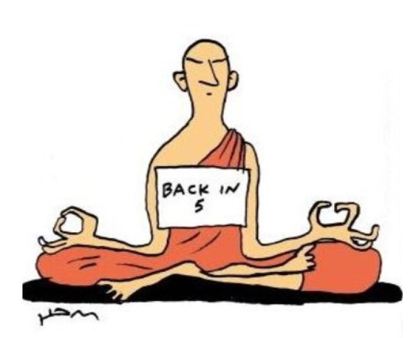
Back in 5

According to a 2012 survey conducted by National Center for Complementary and Integrative Health, about 8% or 18 million Americans practiced (in 2012) some form of meditation. Probably even more  have briefly tried some meditation and have dismissed it because they found it very difficult, since instead of stillness and being in the moment our thinking minds (or fidgeting or cramped bodies) tend to run away from us into the future or the past.  We tend to be stressed out in a fast paced world, being a product of evolutionary biology, designed to “survive” the environment.  True, but please consider that meditation is an opportunity to take a little time out and explore the ultimate depths of one’s being.  It can turn out to be a joyous experience and is a great privilege (as a human being), so if you try it, be gentle with yourself and approach it with ease.   It works best and gains momentum if you make it a habit for life.   If you continue meditating and keep coming back to the present moment you may see things very differently.  Physically, by calming down you may “survive” better.  From a Buddhist perspective the “stick- with-it-ness” hinges a lot on right effort or diligence and, further, a process of letting go of attachments.  Below is an excerpt from a little piece entitled The Zen Habits Guide to Letting Go of Attachments:

What you’ll find is that your mind runs away from the present moment, attaching to worries about the future, planning, remembering things in the past. In meditation, you practice letting go of these mini attachments, by noticing what your mind is doing and letting go, returning to the present moment. This happens again and again, and so you get good at it. It’s like muscle memory after doing it hundreds, thousands of times. You learn that whatever you were attached to is simply a story, a narrative, a dream. It’s not so heavy, just a bit of cloud that can be blown away by a breeze.

Meditation has always had its draw as a portal to “somewhere else,” (but not necessarily an escape from what is truly important).  I suspect that today more than ever, we may wish to seek healthy antidotes against stress and a means to gain greater clarity in our lives  — meditation may fit that need for many.  One word of caution for those carrying heavy trauma or experiencing other extremely strong emotional issues.  While sitting, sometimes coming directly in contact with our strong negative feelings can be extremely frightening.  Although rare, meditation can trigger sadness, hallucinations and even psychosis.  Over time you may find that coming face to face with one’s demons and embracing them (forgiveness and unconditional love for the self and other and seeing emotions as passing states) takes away their power, but easier said than done.  This is why meditators benefit from a support network of like-minded people and teachers.  Professional therapists may of course be of assistance as well. 

Mindfulness has become almost a household word.  Please explore the term “mindfulness” on your own; I will just say that mindfulness, being present and aware of being present (perhaps together constituting hyper-vigilance), and concentration (one-pointed focus on something) are all part of the essential fabric of the meditation process.  While you may need a small amount of these “tools” to start, the process itself can develop these attributes.  Meditation is  trendy according to this article — The Meditation Generation.  And of course there has always been a thirst, overt or covert, for ultimate truth, a higher power, God, Being or whatever you want to call it — regardless of age.  There is also the allure that meditation may produce super powers.  Manga has popularized some aspects of Buddhism and perhaps the idea of super powers.  In most Eastern practices one is warned not to be distracted by seeking  special powers, as that will likely feed the ego and ultimately produce spiritual set-backs.  If anything the real super power is the real “you.”  While each individuals’ results will vary, the benefits of my personal practice are slowly starting to bear fruit, in the form of calmness and insight.  Of course, there is still an elephant in the room.  But the elephant isn’t necessarily a problem (See The elephant in my room.)

For a number of baby boomers during the 60’s and 70’s there was a certain allure and fascination with Zen Buddhism, motivated by such “cult” figures as Alan Watts  and Jack Kerouac.  Their voices spoke to our sense of wonder and imagination. Then of course the Beatles started meditating, and there were also the gurus of the psychedelic counterculture, most famously Tim Leary  and Richard Alpert (who later dropped the drugs and became  Baba Ram Dass ).  When I took up meditation in 1969 it was to seek “enlightenment.”   I had no clue how meditation worked or how it applied to “enlightenment” (which I imagined, once successful, to be like the Silver Surfer surfing through the Universe — Hah!) — and I used “mail order” lessons.  Today there is an abundance of material and many caring people available to guide those wishing to explore meditation.

There are multiple definitions for the word, meditation.  My description is that meditation is a term for a very broad variety of techniques used by people since ancient times to transcend ordinary subject-object dichotomy through detachment from the sense-thought process and as a result directly experience reality.  Maybe another way to think of it, using a radio analogy, is that prayer is transmitting and meditation is receiving.  It is interesting to note that some dictionary definitions state that meditation is contemplative thinking.  Contemplation as a meditation activity stems in part from the mystical side of Christianity; e.g. focus on the aspects of the Devine (one example).   For an introduction please see Christian Contemplation.  My personal interjection here is that 1) contemplation could lead to run-away thinking, and  (2) contemplation on the Divine might presume one already knows what the Divine is.  In any case, across all types of meditation there are many potential pitfalls or “traps”; however generally these activities have positive aspects and are not simply a waste of time “staring at ones navel.”  Meditation implies attention or focus (mindfulness and concentration) and should bring periods of a mentally clear and emotionally calm and stable state (as pointed out in  the Wiki).   In other words, from a Buddhist perspective it should bring results that help relieve your dissatisfaction (suffering) and I might add, follows the “Middle Way,” between extremes as described, for example, by SGI.

Traditionally, most of these techniques and approaches have been associated with various disciplines and/or religious traditions, primarily Eastern, seeking a greater Truth or God but there is also an emergence of “secular” practice to relieve the stress of “modern” living.  An interjection — we can easily fall into the trap of labeling faith-based systems as “good or bad,” or non- Christian systems as “good or bad,” but this is not the point of the discussion, and quite frankly the more we label “good or bad,” without intimately understanding what we are talking about, the more we exhibit our ignorance.  Science is substantiating the benefits of meditation and meditation techniques are increasingly being  employed in the mental health field.

A commonality among traditional meditation techniques is that the person is still, or attempting to be so, and the spine is straight.  There is also walking meditation, which can be very beneficial, but here I am talking mainly about the sitting type (for those that cannot sit or walk, there is even prone meditation).  Here is what the Wiki says about meditation.  For those wanting to get right into it, the UCSD Center for Mindfulness offers some excellent web-based audio guided meditations.  The 20 minute body scan, by Hickman, is done lying down. So in essence prone meditation.   It’s a good place to start to get the flavor of the power of focusing our attention where we usually don’t.  It’s also a great relaxation technique!

The book by Goleman and Davidson, Altered Traits , is a thorough and ground-breaking summary synthesizing scientific studies on meditation.  The authors include a classification of meditation techniques into three broad groups.  The first is Attentional.  These techniques focus on training/improving aspects of attention with probably the most common one being focused on the breath.  Also included in this category are mantras (words or sounds repeated verbally or mentally, or sometimes in unison with breath), various concentrations on mindfulness — i.e. observation of experience, and finally, open presence, or what has been termed hyper-vigilance.  The second type is Constructive and involves cultivating virtuous qualities like loving kindness and compassion.  The third type is termed Deconstructive .  These methods use self observation to “pierce the nature of experience… They include non-dual approaches where ordinary cognition does not apply. ”

The following is a rundown of meditation techniques that I have used.  There are many individuals and institutions that will tell you that their technique is the best.  My personal view is that each potential meditator has to determine what works for them.  So, no specific recommendations, other than you will likely lean on resources in your area (or online), making decisions based on how you feel about the resource provider and the results you are getting.  Of course, beware of organizations that push you in a certain direction, take $$ or make you uncomfortable.  It is your decision.  My earliest introduction to meditation was hearing about Transcendental Meditation from a classmate, while still in high school.  Over the years I have used a number of techniques, including Kriya Yoga, the Hong Sau technique, Transcendental Meditation and finally, “just sitting” or Shikantaza.  After recuperating from a serious car accident at the end of my senior high school year, I saw a small ad in the newspaper regarding lessons through the Self Realization Fellowship (SRF), founded by Paramahansa Yogananda.  This organization is genuine and sincere, with a very devotional approach, which may cause pause for some.  The meditation techniques offered, including Kriya Yoga and and Hong Sau; however, are vital ancient yogic meditation techniques involving breath, mantra and visualization.  Lessons for a nominal fee are available through SRF.  There is also another organization called Ananda, founded by one of the disciples of Yogananda  that offers similar instructional material.  I think both organizations present valid material.

I added a Transcendental Meditation mantra to my “toolbox” while in college.  This is a silent mantra, customized to the individual by a teacher, ideally to be done twice a day while sitting with eyes closed.  I found the mantra to be quite enjoyable and peace-producing, while some others who tried it had more negative results; for instance, they simply did not like the mantra sound.  Beware that it is pretty pricey, with no guarantees.  A great summary of techniques under the umbrella of Hindu based practices is offered  in the thewayofmeditation blog, which also has some really nice material regarding how to do some basic meditation, guided meditations and useful commentary.

Nowadays, I enjoy a morning routine of Kriya Yoga, which lasts about 20 minutes and an afternoon half-hour meditation along the Mahayana Soto Buddhism style Shikantaza.

To meditate, you don’t have to sit cross legged or in the lotus position on a cushion, although the ancients found that this was a great stable “immovable” position offering a solid base and straight spine.  Good to try if you are young and nimble.  Really, sitting in a straight-back chair or an ergonomic meditation chair works great.  I find a meditation bench, where you lean on your knees to be useful as it opens the chest and is bearable on (my) legs.

Meditation Bench

As outlined in references cited and elsewhere, the simplest meditation is to simply focus on the breath’s inhalation or exhalation, staying focused, perhaps counting breaths to ten and then starting again.  It is important to do the routine with focus and concentration, even if for only five minutes to start, rather than “gutting it out” and creating yourself a painful experience by meditating for half an hour or more for starters.

For some, reciting a mantra may be the easiest.  This is usually done silently, but if done aloud, becomes a chant.  The most universal mantra is Om (Aum).  The Hong Sau technique combines a single syllable mantra with breathing, with the “Hong” mentally chanted during inhalation and the “Saw” during the exhalation.  While there are a number of videos available for this technique on the Web it may be best to contact SRF or Ananda, or a local qualified teacher.

The Kriya Yoga is a more complex technique requiring concentration on a cool in-breath and a warm out-breath, visualizing the cool energy ascending up from the base of the spine via an imaginary tube or thread to the point between the eyebrows, and then descending down again as a warm current to the base of the spine.  Along with the visualization there is a mental mantra sound both for the inhale and exhale (not the same as Hong Sau) and a focus on the third eye (point between the eyebrows).  I emphasize that if you want to try this technique, contact SRF.  The goal of the Kriya Yoga technique is to quiet down the senses and the achieve a state of pratyahara  — sense withdrawal.  Yogananda’s explanation indicates that this is a “scientific method” that oxygenates the blood and allows heart rate to slow down.  To my knowledge there are few or no studies to date on Kriya yoga.  This technique works for me by producing a very peaceful  and joyous state.  I think it is a good tool for letting go of the little self.   Focus on the point between the eyebrows may produce what the Wiki calls closed-eye hallucination or CEV.  From SRF or Ananda, this may be what they refer to in describing the Spiritual Eye (also corresponding to the sixth chakra), usually depicted as a light with gold halo, blue middle and a bright five-pointed star in the center.  The Spiritual Eye is depicted as a spiritual gateway.  So, is this all just BS? The lights are clearly not, as I and many other Kriya  practitioners have seen them.  But to see the “eye” as depicted by Yogananda in a most lucid description is past my experience:
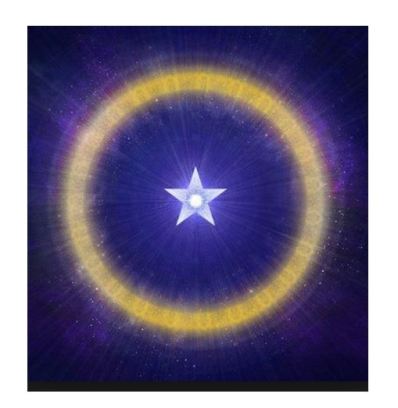
Third Eye

Of course there are stray lights that we see with eyes closed and when you think about it, where does the light come from that illuminates your dreams?  For that matter, in everyday life, since it is dark inside the brain, how is a “photon” hitting the retina translated in the dark place of the brain back into the light that you perceive? (adapted from Deepak Chopra, You are the Universe.)  Of course science will tell us that the light energy is focused by the eye mechanism and then converted to an electro-chemical signal and sent to the brain for processing.  Does that help? Ultimately this is all wondrous and mind-boggling and certainly suggesting that nothing is quite like what it seems.

I indirectly mentioned chakras, referring to the third eye or spiritual eye.  The chakra system in relation to meditation as developed in Hindu Vedic and Yoga traditions, and also practiced in Tibetan (Tantric) Buddhism, is a bit out of my area of knowledge or “comfort.” There have been few studies by western medical practitioners or those studying effects of meditation.  With that said, the body’s nervous system and the spinal nerves are certainly “players” in mantra/breath/visualization techniques such as Kriya and certain Tantric practices.  Advanced Kriya is said to utilize visualizing energy associated with various of the seven chakras.  Those of a more bold spiritual bent than I will confirm that the chakras are part of an “astral body” (spiritual body) — again unproven by any science (or perhaps not yet discovered?).   In the literature there are some works comparing (mapping) the body’s nervous system with  chakra  and nadi (channels for spiritual energy) locations; for example see an article in the Journal of Indian System of Medicine by Khedikar and others.  Another way to approach chakras is seen through work done by John E. Nelson, MD who notes that while Western minds tend to see consciousness arising from the brain, Eastern systems hold that the mind and body arise from consciousness.  Nelson is essentially a spiritual therapist working with mental illness cases.  For practical purposes he suggests viewing the chakras as metaphors or icons for human development, with each chakra representing a discrete level of consciousness.  On might add that the brain waves of advanced Tibetan yogis (who often use techniques associated with chakras) show very unusual and maintained theta wave states that are likely manifested in altered states of consciousness.  But  as my daughter, a medical student, asks “what do these altered brain traits mean?”  Maybe the answer is to try it for yourself.   A final note: although many may dismiss the idea of chakras at best, and poke fun of them at worst, our emotions, especially love and sorrow,  seem to emanate from the body, in particular the chest or heart area (heart chakra?).  So since science suggests that love is due to neurobiological signals, additional study is probably warranted.

These days my Mahayana Buddhist Shikantaza practice brings true moments of peace.  Shikantaza, or “just sitting” requires alert hyper-vigilant sitting, being aware of any and all phenomenon in ones awareness.  There is no mantra, no particular focus on breath, just sitting and awareness– like walking a precarious path with no hand rails.  When you have a thought, you recognize it and gently let it go.  Ultimately, the “question and answer” is who is it that sits and experiences?

To sum it up, especially for those wanting to pursue advanced yoga and Tantra techniques, a teacher is strongly recommended.  Maybe attend a retreat in  India; or for that matter, there is a mind blowing variety of yoga vacations and retreats available in the U.S.  For those inclined toward Zen, or other forms of Buddhism that include meditation, most U.S. cities offer at least several options; so shop around. Most Zen centers offer teachers and spiritual counseling as well.

Next time, in part 2, I will provide some wrap-up perspective regarding information presented here, including why meditation might “work.”  I will also discuss the non-sitting part of “practice,” which is an important part of yoga and Buddhist practice and other major world religions as well.  After all, it may be relatively easy to get some tranquility while meditating, but life happens largely elsewhere.


The Normal Life Interrupted by Snapchat Dysmorphia

Some days I am downright bothered by the fact that there is this being inside my head seeing an angle of the world from what appears to be a very limited perspective.  (What? This “being” and I?  How can there be two?) Then again, maybe people collectively have a pretty good view of the world from all “angles,” thus the importance of communication empathy and compassion — what we ingest and what we place into the world.  Science has amazingly extended our ability to see the physical world – nevertheless, we “see” it “second hand” through our sense organs and our thinking.  We appear to have this one body and for sure this current life in a very interesting place seemingly governed by predictable laws, like gravity, but readily influenced by unpredictable events as well.  Some of us have better fortune than others (good Karma, luck or whatever you want to call it) having been born into or currently living in a place where events or situations allow us to rise above the dire need to focus primarily on food, clothing, shelter and safety – for ourselves and our families.  Having this privilege, many choices are often available for our life paths. Ironically, despite the privilege of a “good life,” many of us want to be different, something we are not, or a better looking, a “better dressed” and perhaps more adventurous soul – like our doctored selfies!  It’s a phenomenon called snapchat dysmorphia.  Maybe life is not normal at all but rather a bit strange. Ask Walter Mitty.

Wanting to be someone else or perhaps somewhere else could be considered an attribute of human nature. But what do we really want?  It can all add up to confusion.  See the lyrics of Ballad of Thin Man by Bob Dylan, “…something is happening here but you don’t know what it is do you, Mr. Jones?”  Buddhists note craving as the root of why we suffer in this world.  I suspect that people often want to be different or somewhere else because they envision the change will bring them things they are currently lacking, and bring them happiness.  Craving while being yourself or, conversely, changing yourself or your environment may be two sides of the same coin. You are still there with the same potential problems; the cycle of craving keeps going.  Ironically, whether we want to change or not, we are always changing, both physically and mentally.  The initiation of volitional actions to change ourselves may create a positive or negative situation.  For example, gender re-assignment may lead to a much happier life – or not.   The bottom line though is that the change is fleeting, slippery and likely will morph as we move through time; and, as we move through time, our actions shape our lives, like a growing snowball hurtling downhill (you know what happens in the end).  Included in volitional actions are intoxicants.  Certainly heavy drug use would be a negative in context of physical and mental health.  But it’s so tempting to want to be out of your head!  And, any changes we initiate are not done in vacuum, so they create impacts, karma, in the world around us, not just for ourselves.

Maslow’s hierarchy of needs theory of human motivation provides an interesting framework and perspective on the human condition.  Maslow argues that once basic physiological and safety needs are met, the human is motivated to seek (in an upward order), social belonging (love and belonging), esteem (feeling good about oneself) and self-actualization (be all that you can be).  Later, Maslow added self-transcendence, or as he put it, the desire to reach the infinite.

The esteem and self actualization steps of the hierarchy of needs are ripe with decision making. Arguably, if we climb a social ladder and accumulate wealth and/or knowledge as power we can end on a slippery slope.  The negatives of capitalism and a “be-all-you-can-be” may take the face of ugly Machiavellian striving and screwing the “little guy.”  Moral and ethically balanced behavior becomes transactional.  Very important point: studies have shown that wealth reduces compassion and empathy.  So, lower income groups tend to be more empathetic and compassionate as a social norm.  This may be due to simple survival skills within the group where resources have to be shared and cooperation essential.  One takeaway is that attributes of self actualization may be repeated across different social classes and exhibit different outcomes or behaviors and you don’t have to be that wealthy to gain a  good head space.  Like, what’s really important to you once you have Maslow’s basics?   Being less “selfless” does not necessarily lead to happiness if one is in dire poverty — it may simply safeguard survival. For those higher in the hierarchy it becomes a challenge to rise above the fortress we build around ourselves (in part with money), our identity.

(It seems that love and belonging would be an extremely important foundation and is really a bridge between physical well-being and the higher goals as described by Maslow.  Loving parents, teachers and friends allow us to feel good about ourselves and our world – only then can we securely explore further.  Clearly a lot of anguish is felt by those who feel they were not loved adequately as children or by those who grew up in unloving angry or unstable homes or communities, or for that matter in a war zone.)

My take on life is that everything people do above the basic physiological and safety needs (including living in a gated community or being well-armed or driving a Mercedes with a five star crash rating) has to do with seeking the “infinite” and ultimately self transcendence.  We just don’t know it.  Ironically we can lock ourselves up into a very rigid framework and a “tiny space”, whereas the opposite may be more like the ultimate reality.   Maybe to take this seeking out of the clouds, let’s just say we are all seeking meaning for our lives.    After questioning a Zen monk about such things, she told me that it sounded like I was tied up in knots.

Another way of looking at it, in context of the hierarchy of needs, is that of course who we basically are is framed by our physiological needs – namely we are complex biologic organisms with a seeming boundary between “out there” and “in here” and a built in desire to survive.  This is a “starting point reality” and a simple fact of the phenomenal world.  Not even a Buddhist will really tell you just don’t exist (you are just not permanent in this world).   As we go up in the hierarchy, the body can take secondary importance and the “head” may seem like it is in charge.  This is where we can get into trouble.

We are generally raised, at least in western society, to have high self esteem, and be “ourselves.”  Big ego and a sense of “I/Face” is OK as long as you don’t squash mine.   Most westerners don’t talk much, like Buddhist or Hindus, about impermanence and death.  It doesn’t sell well and is quite frankly a bummer.  Change and our demise (and the flavor of it) is a basic law.  That not withstanding does not stop us from wrapping ourselves in the phenomenon of the world and fabricating our identity based on what we have done (our accomplishments), what we “possess.” and ultimately what we think.  Thinking can be viewed as kind of a sense organ, but what if our thinking is off base?     We become what we do and what we think – including identification with Country, sports teams, various like-minded groups, etc.  But the mental states also are fleeting and changing all the time.  As life takes many curve balls and the ravages of time (aging) take their toll, as well as the impossibility of never being “perfect”, it seems like we armor ourselves ever more into a fortress of “I,” including augmenting the “I” with cosmetic surgery if we can afford it. (I think of our mental constructs as “tattoos of the mind.”)

Wait, stop! This is normal.  This is what life is and there is nothing wrong with it other than maybe there is more to life than just a rat race.  In no way do I want to understate the many amazing selfless actions and sacrifices that so many people on this planet, past and present, have undertaken – and amazing humor, arts and feats.  Matter of fact, at the self transcendence level of the hierarchy we would loose identity with a little self and identify with greater chunks of “not-self.”  (See earlier note about poor having more compassion and empathy than the rich).  It’s just that aversion and grasping (avoidance and desire) causes a lot of pain in our lives.  If only we didn’t take ourselves so seriously.  To ease any anxiety regarding the discussion so far, Buddhists have a doctrine called the Two Truths about relative and absolute truth.

A further perspective on existence is that there is experience which is a subjective interpretation by the self and then there is individual action which is real.    Ultimately our life story is an experience, and the “movie” (our self perspective) is solely our experience.  No one else can see the world through you and no one else sees it quite the way you do.  However, by what you say and do, your actions, you create karma, ripples in the world and thus influence others experience.  You can kill them or you can love them!  This is as real as it gets.  Your behavior and actions creates feelings in others.  Feelings lead to everything from Love to War and hatred.   My wife admires this saying:

Maya Angelou

This is why religions and societies have moral and ethical rules of conduct and action, for example the Ten Commandments or the Buddhist Eightfold Path and related precepts.  It’s not so much the “thou shall not” but rather that the effects of living by these moral codes may be more akin to the nature of ultimate reality and move you into a better mental place.

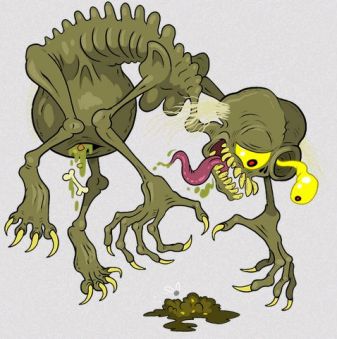
In the Chinese and Japanese traditions there are Hungry Ghosts or Gakis, beings that live in the ghost realm who have insatiable appetites but with a physiology (or a mental construct) that does not allow them to consume or enjoy the object of their desires.  Ever been a Hungry Ghost?

Gaki

 “There must be someway out of here, said the Joker to the thief” — Jimi doing Dylan’s  All Along the Watchtower .  With that said there are techniques to help evolve our little selves (and not suffer like the Gaki!).  These include meditation and a whole family of actions what I call “surrender.”– Meditation next time.  Where does this take us?   There is a purpose to existence, and you are it!  A great 7th century Chinese poem, the Sandokai or Harmony of Difference and Sameness frames phenomenon and “non-physical” spirituality.  While humans seem solid, it can be said that the mind itself is the great mover of civilization and it may be well worth ones while to spend a little time each day in stillness.  The resulting benefits may actually be one way to do our part to make a more positive and harmonious world.

One of Many Paths Toward Enlightenment – Yogananda and a Visit to the SRF Hidden Valley Ashram – Kriya Yoga, Buddhism and Good and Evil

My roots are in Yoga, but I am also confirmed as a Lutheran and Episcopalian.  Lately, over the last five years or so, the path has included Zen Buddhism.  This blog will focus on the Yoga aspect, primarily my first method, and will reflect on our choices along the spiritual path.  (What the heck, we have free-will!

I recently visited my good friend from college days (U.C. Santa Cruz) who lives near the, Hidden Valley Ashram, a men’s monastery, located in southern California in the hills above Escondido.  The Ashram is affiliated with the Self Realization Fellowship  (SRF) founded by Indian swami, mystic and guru, Paramahansa Yogananda.  I had introduced my friend to the SRF organization back in 1969 and had just started taking the SRF lessons that summer, after a near fatal car accident

Yogananda was encouraged by his guru, Swami Sri Yukteswar to come to the United States and spread the “science” of Kriya Yoga to the west.  Yogananda arrived in the States in 1920 and eventually established the Self Realization Fellowship (SRF), with headquarters in Encinitas, California.  Surfer’s still hang out at Swami’s Point and ride the waves below the SRF grounds.  Yogananda is the author of Autobiography of a Yogi, which is fascinating book whether you follow spiritual matters or not

Today, Self-Realization Fellowship has grown to include more than 500 temples and centers around the world and has members in over 175 countries. In India and surrounding countries, Paramahansa Yogananda’s work is known as Yogoda Satsanga Society of India (YSS), which has more than 100 centers, retreats, and ashrams.

A kind of humorous, but factual, article on SRF, including a stay at an SRF retreat at the Encinitas Ashram is described here: What Goes on Behind the Walls.

The SRF approach is very devotional and theistic, and interestingly includes Christ within the lineage of SRF gurus.  While one may think this was Yogananda’s way of enticing westerner’s to yoga, it turns out that not him, but his guru, Yukteswar, supported the Guru-Christ lineage.

SRF teachings are offered online at a modest cost. The flagship technique taught is Kriya Yoga which is preceded and/or complimented by other less complicated, yet effective techniques.  Kriya yoga is said to be an ancient yoga method and reintroduced via the SRF guru lineage in modern times.  The technique is also offered by several other organizations which claim a link to this lineage.  Kriya yoga definitely requires a teacher, or lessons and descriptively involves using both a mantra and visualization techniques, moving energy virtually up and down the spine.  The Kriya yoga system consists of a number of levels of pranayama, mantra, and mudra based on techniques intended to rapidly accelerate spiritual development and engender a profound state of tranquility and God-communion. As Yogananda describes it: “The Kriya Yogi mentally directs his life energy to revolve, upward and downward, around the six spinal centers (medullary, cervical, dorsal, lumbar, sacral, and coccygeal plexuses)…One half-minute of revolution of energy around the sensitive spinal cord of man effects subtle progress in his evolution; that half-minute of Kriya equals one year of natural spiritual unfoldment.”  Explained in the method is that human life is enabled through the cosmic energy of God.  The visualization of energy and the power of the technique are explained as occurring in our astral or subtle body and the six spinal centers correspond to what are called chakras.  Now of course, there is no scientific proof for an astral body, or for that matter chakras, but benefits of pranayama techniques or even some basic deep breathing have been shown to have positive health effects.  While there are a lot of skeptics regarding chakras and non-physical bodies, quantum physics theories certainly allow possibility of such phenomenon.

Here’s my take on Yoga, SRF and Kriya yoga.  At the Hidden Valley Ashram, I saw many happy people.  They were not just happy for themselves, but happy for each other. There was a lot of power there!  Any belief system that gets you to accept life and drop the “fighting and grasping” is good.  We are all different and some prefer (or simply accept) a more devotional approach (yet that is not necessarily the core of Yoga), which is fine and can be very soothing.  It is nice to know that there is a Loving God who ultimately takes care of you and in the end it will all turn out OK.  There is really a plethora of Yoga methods (besides Kriya) and I think in order to be “serious” about them one has to have a teacher or belong to a group.  Does Kriya Yoga work for me?  Yes.  I practice the basic Kriya and it puts me in a calmer space where I can get closer to seeing Reality without the “busy” ego getting in the way.  Or, as Yogananda puts it, “When the mind is calm, it becomes the altar for the presence of God.”  I find that it complements Zen style sitting, where the ego sits in the shadow of non-thinking.  No technique is an end in itself.  Both SRF teachings and Buddhist teachings bring up the analogy of the wave versus the Ocean and both approaches are about dissolving the negative aspects of the ego—the restless delusive consciousness of ego, in order to find the ocean of our true Selves (described by Yogananda as Soul and Spirit).

While best known for Autobiography of a Yogi, Yoganda’s lengthy and exhaustive translation and interpretation of the Bhagavad Gita, which he subtitled God Talks with Arjuna, in my opinion is his most important work.  The link provided is from Amazon and the reviews are pretty indicative of the immense amount of metaphysical information in the book.  Of course, very little of this, namely the metaphysical description of existence, has been proven or indicated by science to date.  In a nutshell, it is God who thinks creation and is the source for our existence, which includes three bodies – the causal or consciousness body, the astral or life energy body and the physical body.  In Vedic, Hindu and Yogic traditions there is an individualized “soul” which is the individualized reflection of ever-existing, ever-conscious, ever-new Joy, confined within the body of each and every being and is the true Self, whose ultimate source is Spirit or the non-dualistic God.  (Buddhists philosophy tends to encourage cutting out the “middle man” and to just go for the non-duality).

The Great Battle of Life
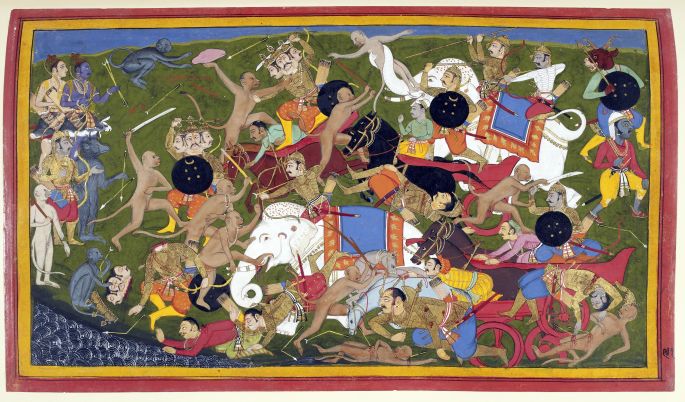
Elucidating on the Gita’s primary metaphor of inner battle, Sri Yogananda writes, “From the moment of conception to the surrender of the last breath, man has to fight in each incarnation innumerable battles: biological, hereditary, bacteriological, physiological, climatic, social, ethical, political, sociological, psychological, metaphysical — so many varieties of inner and outer conflicts. Competing for victory in every encounter are the forces of good and evil. The whole intent of the Gita is to align man’s efforts on the side of dharma, or righteousness. The ultimate aim is Self-realization, the realization of man’s true Self, the soul, as made in the image of God, one with the ever-existing, ever-conscious, ever-new bliss of Spirit.”   Yogananda goes on to explain in the book that the Ego is the evil and the good is the ultimate, if you will, Godhead.  I love the fascinating picture from the Ramayana, Battle of Lanka, a Hindu/Vedic story that preceded the Gita but has the same epic battle theme between good and evil.

Battle_at_Lanka,_Ramayana,_Udaipur,_1649-53

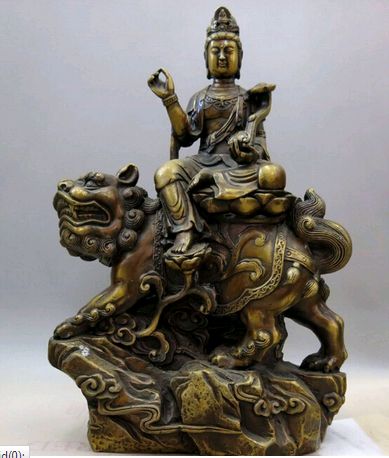
I think Buddhists also do great battle with the ego, but often it seems more cloaked —  namely rather than engaging actively in the battle, Buddhist observe the battle in themselves. However, depending on the flavor of a particular Buddhist tradition, there are plenty of metaphors referring to swords cutting the grass (or even heads!) of delusion and of course the famous Bodhisattva, Manjusri, sitting on the demon (of the mind) Lion/Dog.

manjusri

Both Yogic and Buddhist traditions ultimately strive to eliminate the delusive nature of ego and its grasping which simply is the noise and agent of misery that keeps us apart from ultimate Reality.   Practicing pranayama techniques, including Kriya yoga,  if it gets you closer to the place where you are not fighting this and that (are ready to let go), seems compatible with the ultimate goal of realizing our true nature.   Further, Yogic and Buddhist traditions teach us to cultivate positive habits and actions – replacing good with bad – this may be the very fabric and foundation of both practices.   But wait that is not all!  By eventually letting go and realizing our true nature we also give Love and Joy to the Universe!  We are that important! If Science gets to write the last sentence, it will be that there is one true Reality regardless of how you get there.  Let’s just hope that the equations are simple.  Keep in mind that Buddhism came from India and the two paths are historically intertwined.  Follow your heart and recognize that your path will reflect who you are.

Anger and Other Emotions – More Than Meets the Eye

One of the precepts in Soto Zen study states “Do not indulge anger – cultivate equanimity.”  Equanimity — “chill” or keep calm.  Notice that the precept does not say don’t be angry, rather it states don’t indulge your anger.  Of course all of us except full-blooded Vulcans are swimming in a sea of emotions, and the behaviors they may induce in us could have an immense influence on the dynamics and outcomes of not just our lives, but also for our families, communities as well as society at large.  Some emotions can be extremely powerful and collectively may lead to war.  Emotions can trigger murders and suicides, so it is well worth for all of us to dwell a bit on the topic of emotions.  I also want to share and bring in a piece from the fascinating NPR-hosted pod cast, Invisibilia, which touches on a recent model or way of looking at emotions and provides some insights how trying to “control” or dismiss emotions can backfire.

Recently, I attended a class at the local Zen center and we were asked to list three things that made us angry.  Being the analytical type I ended up trying to convert my top 3 into a generic format.  Bear with me.  This is what was finalized:

  1. Angry people make me angry.
  2. Anyone or anything that threatens my safety or the safety or sanctity of what I hold dear in the world (which includes people, animals, things and my “favored” mental constructs). For example, the actions of predators…
  3. What I can’t control. For example, getting sick, others I care for being sick or willingly harming themselves with intoxicants, people doing things I don’t want them to do or I perceive are wrong, rude, etc, people or situations that I am jealous of.

Summing it up:

-Anger

-Threatening Situations

– Lack of Control

Think about it a little bit.  Go back to a situation where you confronted someone in anger.  Didn’t your adversary’s anger escalate yours?  So keeping cool helps de-escalate a potentially harmful situation.

During the exercise I began to realize that these generic “global” triggers (threats and lack of control) may also be manifested as fear, irritation, worry/anxiety, guilt, remorse, sadness, pity, jealously and hatred – to name a few.  But from a place of equanimity they are capable of triggering empathy and yes, even Love.

From a Buddhist perspective anger clearly causes suffering, as do threatening situations and lack of control.  Let’s face it, anger is suffering and suffering can make one angry.  The suffering is not just yours, but everyone’s.  (For more see Google search on what Buddhism really says about anger.)

It may also be helpful to think about emotions in context of time – past, present and future.  This may be useful, as we at times may be flooded with totally virtual and hypothetical situations that we play out in our heads and which can cause, literally, a personal hell.  Parsing it out and seeing it happen inside, from a detached perspective and in the present moment may be a good tool for relief.  Past-based originating emotions include remorse, guilt, anger, hatred, and sadness.  The point is, something happened in the past and we keep spinning the event in our heads rather than approaching from a clear and calm place.  That is not to say that injustice may have happened, but the suffering continues after the moment of occurrence.    A popular Buddhist saying is “Holding on to anger is like grasping a hot coal with the intent of harming another; you end up getting burned.” Future-based emotions include fear, worry and anxiety.  It has not happened yet, but our sense of self, or maybe our sense of happy self is threatened by the possibility of a less than optimal outcome – the cards are stacked against us.

Apparently for 80 years or so younger Americans have been getting more anxious and depressed.   For as long as there have been intoxicants, humans of course, have had a tendency to try and let go (of their negative junk) by that method.  If taken too far this is simply avoidance, with likely long term negative consequences (addiction, poor health, etc).  But having an occasional margarita can also be just plain fun!  Too bad that alcohol is a depressant.  Medication combined with therapy is a well accepted tool by the medical community and according to a recent study on depression treatment, statistically works — and is likely to be the fastest remedy for cases of acute suffering.  Moving on to non-drug treatments, increasingly the eastern aspects of mindfulness are being applied in western psychology, such as mindfulness based cognitive therapy.  The neural mechanisms that provide positive results, however, appear to be incompletely understood at this time.   From my perspective, meditation, including mindfulness, can be useful to create a gap from what seems like incessant spinning of thinking and emotions.  That gap is in the present and from a calm place “we” can detached from the past and the future, even if it is just for a few moments.

Mentioning the word, “detach”, another approach to deal with the negative consequence of emotions and emotion-induced situations may be to not allow those emotions to have “fertile ground.”  By this I mean utilizing the concept of “surrender” (more of a Christian mystical concept of giving oneself to God) or the concept of detachment recognizing no permanent self or certainly nothing like the self we think we are (eastern philosophy, Buddhism for the no-self and Vedic/Hindu Philosophy for a more complex “cosmic” self).  In all cases the wave recognizes it is part of the sea or part of God, thus allaying its fears that it is about to crash onto the beach, is bigger or smaller than the other wave, etc.    While “self annihilation” or “surrender” may sound scary, especially for westerners, don’t worry, it’s pretty hard to do and not what we think it is (I suspect).  Hanging out with good friends who want to help each other or with a spiritual community with open hearts is a nice start.

In the Invisibilia segment entitled emotions; part 1 is a chilling story of a truck driver, handle of Ninja (Tommy), who successfully sued a family for emotional distress after a horrible accident where, ironically, the family’s little girl was killed after the husband had lost control of their car on a slick road, crossed a highway divider and hit Ninja’s truck.  It turns out that the trucker was raised to control his emotions, and be in charge and always be in control.  In this situation that he could not control, after seeing the limp arm of the dead small child, Tommy labeled himself a killer and essentially withdrew, being unable to work or look anyone in the eye.  Almost a year passed by until he received help and was diagnosed with Post Traumatic Stress Disorder.  His emotions hijacked him.

Another example, also involving PTSD, centers on the main character, Chris Kyle, in the film American Sniper.  The movie is based on the real Chris Kyle, a legendary sniper who served four tours in Iraq.  Chris seems to be cut in the same mold as the Ninja, a guy who is in control.  In his case while being clear on why he was in Iraq (to protect freedom and get the bad guy) he becomes conflicted having to shoot (armed) children and women, in order to protect U.S. troops.  When asked later if he had any regrets, apparently his response was that he regretted most not being able to protect and save the lives of his fellow soldiers in certain combat situations.  I bring up this example to point out that things get messy in a hurry.

The Invisibilia podcast has a link to an interview with Lisa Feldman Barrett, a psychologist and author, who has cultivated some new theories and insights regarding emotions.  From one of my earlier blogs it is noted that the brain may be viewed as a tool that models reality and makes predictions of “you” (as the star character!) acting in the future.  Barrett puts it this way — emotions aren’t happening to you; your brain makes them as you need them.   She says, “Your brain is organized in such a way as to [make] anticipatory guesses about what is going to happen next… You are the architect of your own experience.”  She points out that emotional response and personal feeling is maybe a lot more subjective than we are led to believe and based so much on context.  If we are our own architects of our emotions than we may be able to change some aspects of how emotions will affect us in the future by cultivating certain qualities in the here and now – such as compassion, and generally being a kind-hearted, less self-centered and open person.

I will add that we also need to recall that we are a product of evolution, wired to survive (and really don’t know why the hell we are here, but hopefully enjoying the ride) and emotions can be viewed in the classical sense as a module of response to get us out of trouble quickly (rather than just thinking our way out of trouble).  The last thing to note, going back to Barrett, is that she says that there is a distinction between Perception (e.g. we see an object) and perception leading to Emotion (e.g. we see an object and are overwhelmed with its beauty, or maybe horrified, etc).  The two are linked and just two of the five kinds of “stuff” (form, feelings or emotions, perceptions, mental formations and consciousness) that our world is made of, according to Buddhist views on the five aggregates (from Thich Nhat Hanh, “The Heart of the Buddha’s Teachings”).  Western psychology and science appears to be slowly dissecting the same stuff ancient masters have perceived and taught.  We can change how we perceive the world!

Let’s be clear that there is a difference of purpose, or maybe intensity, between using non-drug methods to help ourselves achieve healthier and happier lives as opposed to a more radical and fundamental “diving into” the search for Nirvana or God, perhaps using some of the same methods.  The difference is a personal choice as influenced by circumstance.  The Ninja and Chris Kyle walked a thorny path.


The Brain Models Reality, Part II


Part I discussion had four main kernels or themes.  These were (1) that our brains simulate or model reality, by which is meant they simulate the physical world, (2) per Michio Kaku “Self-awareness is creating a model of the world and simulating the future in which you appear, ”  (3) this self awareness and simulation of the external environment is “special” and (4) science along with ancient methods such as the Buddhist tradition could complement each other in helping humans, to be blunt, survive and also perhaps to evolve.

Each of these themes and concepts are essentially incomplete in themselves but are interwoven in an attempt to make some basic assumptions about human beings including who we really are and where we might be going.  Since I wrote the last piece I have completed a book by author Robert Wright called Why Buddhism is True. That’s a pretty gutsy title and while I personally agree with most of his statements regarding Buddhism (and that does not mean other religions or philosophies are not “true”) the power of his book (for me) was pointing out how we are programmed by evolution or natural selection to behave in fairly rigid ways (in order to preserve the species).  While calling evolution the “creator” (in lower case) Wright stops where science stops, but makes a great case that we as humans have our freedom hampered by the basic need for the physical survival and continuation of the species.  The deal is that factors leading to the tremendous “success” of our species from an evolution standpoint are now backfiring in a big way, not just from an environmental perspective but from a mental health perspective as well.

OK, so when ancient organisms bumped into each other and one ate the other, it would have been to the benefit of the eaten one to have had a way to discern friend or foe (or in a more loving environment mate or checkmate).  The evolutionary path was to evolve nervous systems for defense and procreation.  As Wright notes, that is all evolution cares about.  Perhaps harsh, but in many ways true, as we are programmed pretty much for survival and passing along our genes – the rest is an elective!

This is where the sense of self and self-awareness come in.  So, we (optimistically), or our brains, create a model of the world in order to optimize survival of self and species and we simulate a future in which we appear.  In no way minimizing Kaku’s contributions, we have both foreword projections of the “I” into the future and also past projections of the “I” as memory.  From experience and reading, past and future states are pretty much where most of us live unless we are concentrating or focusing on the task at hand (be it work, art, sports, etc).  Both of these states (as well as the present) can be quite pleasurable or can be quite hellish.  Having opened up Pandora’s Box of pleasure and pain, we can add emotions to the experience we have of the world.   Matter of fact, according to Buddhist teachings the entire Universe is made of the five aggregates which are form, feelings (or sensations), perceptions, mental formations and consciousness.  These include all thought, the model of the physical world gleaned from our senses and consciousness which melds the object with the subject.  Come to think of it, our experience of the world is a rich woven tapestry that in my opinion equates to magic! While the Buddhists contend that the cause of suffering is clinging to the ephemeral “I” within the five aggregates, these are brought up at this time to simply focus back on the sense of self or “I” that science can comment on.

Kaku describes findings that it is the left hemisphere of the brain that engages in the human tendency to find order in chaos and to search for patterns and make “sense” out of them, while it is likely that the medial frontal cortex is the main part of the brain to form a coherent sense of self.  He also uses the analogy of sense of self as a CEO of a large corporation. Realistically, various parts of the brain, essentially modular programs from an evolutionary perspective, together drive us as a species to survive and reproduce. The bright side of evolution is that humans are learning machines – and the brain is noted not to be a digital computer, but rather a neural network “of some sort” that constantly rewires itself after learning new tasks.

Suffice to say here that our society certainly encourages the expression of self; and of course life is precious. It’s just when the ego gets out of hand, and through application of negative emotions — from domestic violence to road rage, to genocide and pulling the nuclear trigger, that our over inflated sense of self, overly powered by the cave-man brain,  may just may put civilization back into the stone age or completely destroy it.

None of this “process” we asked for or understand very well as a species or individuals. It just is.  A few more things before a wrap: Kaku points to findings that from an evolution perspective we may be near the end of the physical limit of intelligence enhancement of the brain via evolution.  So artificial intelligence will likely be the next phase.  As he states “…from an evolutionary and biological point of view, evolution is no longer selecting more intelligent people, at least not as rapidly as it did thousands of years ago.”   I think there are some other possibilities if we “stretch” the concept of evolution – to be discussed at another time.

In future blogs I will talk more about meditation which seems to be fundamental to helping humans dodge acts of harm to self and others.  As the current topic focuses on how science (and technology) may save our butts – the future is now.  Brain research and resulting applications are and will help cure mental illness and create healthier individuals.  Meditation impacts on brain waves can be measured.  Meditation is likely to include greater use of devices to induce and track theta and delta waves in the form of meditation headsets, or mind machines.  Meanwhile, carry on in the physical world since sometimes a tree is just a tree and cheeseburger tastes good.


The Brain Models Reality

The brain is not simple.  It has many parts.  Reality is even trickier since commonly us human beings (at least us mere mortals) perceive reality through the instrument of our brain, as manifested by the mind.  Perhaps that is what Bob Dylan was alluding to in the song Cold Iron Bounds: “Reality has always had too many heads.”  I am writing this piece to suggest that from our western objective and scientific point of view we can make some statements about the brain, essential nature of human beings, and nature of reality that may be helpful to move us past the current mess that this world is in.  After all, we appear to be products of evolution and being an optimist, I believe that we can hopefully apply our intelligence in a positive way. The objective would be to improve the mental hygiene of society by understanding the fundamental nature of existence through the tools of Science, together with application of Eastern Concepts embedded in Buddhist philosophy and other Eastern disciplines (meditation, yoga, mindfulness, etc.)  Along these lines, there is a beautiful article by the Dalai Lama entitled Science at the Crossroads wherein he notes the compatibility of science and scientific discovery with the Buddhist contemplative tradition.  Practical applications of scientific and medical advances in neuroscience may in turn help advance societal mental health and cultivate compassion akin to Buddhist goals. In the words of the Dalai Lama:

If it turns out, as the Buddhist tradition implies, that mental practice can effect observable synaptic and neural changes in the brain, this could have far-reaching implications. The repercussions of such research will not be confined simply to expanding our knowledge of the human mind; but, perhaps more importantly, they could have great significance for our understanding of education and mental health. Similarly, if, as the Buddhist tradition claims, the deliberate cultivation of compassion can lead to a radical shift in the individual’s outlook, leading to greater empathy toward others, this could have far-reaching implications for society at large.

The concept, “The Brain Models Reality,“ stemmed from reading Michio Kaku’s book (he is a theoretical physicist) The Future of the Mind which is a book about developments in understanding the brain.  The term “mind” is loosely used referring to the mental process of the brain as viewed by the person (my take).   Kaku defines consciousness as:

“…the process of creating a model of the world using multiple feedback loops in various parameters (e.g., in temperature, space, time and in relation to others), in order to accomplish a goal (e.g., find mates, food, shelter). “

Here is Michio Kaku describing his ideas, which he calls his theory of space-time-consciousness.

He also goes on to define the term (human) self-awareness.

“Self-awareness is creating a model of the world and simulating the future in which you appear. “

So here you have it, the brain itself is a modeling tool and it models essentially all that there is in the physical world within the sensory limitations of the body. So fundamentally it is all “mind stuff” as we can never truly hug or touch anything. The fundamental nature of our brain’s projections is a simulation of reality. One definition of a model is that it is an approximation (or can be a simulation) of a system that is either too difficult or impossible to display directly.  Refinement of the term model to scientific model might help the reader understand where I am coming from.  But the magic comes when you consider that the simulation itself, the brain’s model, the signals and patterns you see feel and manipulate, is something extraordinary and special.  “We” are part of the subject-object process and, yes, when that tree falls in the middle of the forest and you are there, it is different than when you are not.  This mind stuff, consciousness if you want to call it that, is unique and all that we really know.  Yet, we hardly seem to know it at all.  Perhaps the great Zen Master Huangbo (also known as Huang Po) referring to the Mind was trying to convey something similar:

Huang Po on True Mind_2

Stepping around, for now, recent theories regarding consciousness and quantum physics (there are some brilliant minds out there!), I will just say that there are forces and energies much greater than us, keeping in mind that Buddhists believe there is no separate self. Conventionally speaking we can call these energies and forces the “external world.” It is the world where we might encounter our true love, or the barrel of a gun.   But if there is no separate self, then perhaps it is not so far fetched to infer no true separation between the “inner” and “outer” world at some level, offering us the opportunity to reach what the Buddha called the other shore.

Letting Go and Retirement

The term letting go, or detachment is important concept for anyone attempting a spiritual journey.  We don’t appear to live in a “let go” world; it seems more like a “hold on” world.   Let me add another word, “retirement.”  Leaving my job at the end of 2016 and “retiring” has provided an opportunity over the last 9 months to observe a milieu of emotions and thoughts related to this thing called retirement.  The Dictionary notes that retiring involves withdrawing. I withdrew from my position/occupation and concluded my career.  But retire can also mean to withdraw, especially for privacy: “She retired to her room.”  So, when you retire, you just don’t disappear, in effect you move to a “different place.”  To complicate or perhaps “amplify” my initial retirement experience, my wife and I decided that a two story home was not the perfect future home, so the first 6 month were spent fixing, selling packing and eventually (literally) moving to a new home.  The process continues as we build a place (house to home) in our new location.  So why is this relevant in the context of the Mystic?

These last nine moths have been a shock.  Most of us establish our sense of self, or to expand, a particular society establishes a collective sense of self (we could call it World View ) in relation to our current situation, knowledge-base, occupation/job, family, hobbies, religion, house, possessions, state of health and a plethora of other wrappers; including physical image/body, ethnic origin, sexual orientation, (and moving to the collective — sports, socioeconomic status, country, etc).  These are all attachments. This world view is as seen from the person to the outside, but also on the flip side defines the person or “persona.”  We present an image to others, in part feeding back an image that others imprint on us.  Seems pretty normal and human, right? It’s kind of like having a center and homeostasis.  Through memory we establish a self-schema. We weave and bob in this personal and societal web, or network of attributes, making adjustment through time, since nothing ever stays the same, but collectively for ourselves and our greater society it “stays the same,” sufficiently!  That is the magical illusion we accept.   

My friend, a psychologist, told me that some of the greatest stressors of life are retiring and moving. Wow!  Having some rudimentary skill using Mindfulness I was able to observe some of the attachments in my life.  Mindfulness employed here was to simply watch my reaction and behavior from a quiet, non-judgmental place.  Rip away the routine of work, rip away a place lived in for 16 years. Then build a modified identity… The most important observation for me was that while the physical situation changes the changes themselves manifest as emotions.  In this case the emotions were anxiety, sadness, fear, and on the positive side excitement, joy, and hope.

Letting go conjures some sort of image of falling off the edge of the world, loosing ones identity, etc.  It is very antithetical to what we consider normal life.  I think letting go starts with simply observing our attachments using mindfulness techniques and realizing that there is the Observer that does not have a job, does not get anxious, and seems to extend beyond what we think of as ourselves.  Letting go, is likely more a state of mind than perhaps stereo typically thinking of those who let go as having “given up.” Stuff will keep happening around us, but letting go or conversely not being so attached just might bring Happiness!

What is a Mystic?

What is a mystic, anyway?  And why have I titled the website “Little Known Mystic?” “Mystic,”  besides being a river in eastern Massachusetts flowing southeast into Boston Harbor, is defined by Merriam-Webster for English learners as “a person who tries to gain religious or spiritual knowledge through prayer and deep thought : someone who practices mysticism.”  Perhaps taking a zig where there should have been a zag, Merriam-Webster lists some synonyms as magic, magical, numinous, occult, weird. And I say maybe that this is a detour—to lump mystic and mystical with the occult or religious or, well downright weird?  Moving back up-hill the roots of mystic are intertwined with the word mystery.  So here we have descriptions such as “secret,” “unexplained,” unknown;” including the phrase “not understandable by the application of human reason alone.”   Ok, so we just don’t know.  From a logical scientific exercise we can go circularly (exchanging word for word — example being the definition or meaning of “mystery”).  Life, existence, being is a mystery.  A very cool non-secular definition of mystic was provided by Evelyn Underhill (in 1915!).  “Mysticism is the art of union with Reality. The mystic is a person who has attained that union in greater or less degree; or one who aims at and believes in such attainment.” See Practical Mysticism.  An example of a contemporary writing in blog format, examining the traits of a mystic is available here: Am I a Mystic. One thing perhaps left out, according to my even lesser known mystical friend, is willingness or desire to let go or try and let go of your ego, and your attachments.

The term “Mysticism” seems to have been primarily been used by writers of non-Asian countries, but the fundamental essence applies both in the East and West and we could say that the Buddha was a mystic and certainly many of the yogis/holy men of India.  Finally, I am blown away at finding this super discussion of Mysticism on the Wiki. Please read on.

So this little discussion has exposed a lovely can of worms with them all wiggling around asking more questions!  The snake biting its tale.  But as the intro blog stated, how can some eastern thought such as the Buddhist tradition be translated to the west?  The western culture seems so rational, but even William Shakespeare in As You Like it has his character narrate: “All the world’s a stage, and all the men and women merely players; They have their exits and their entrances, and one man in his time plays many parts, His acts being seven ages.”  Going further according to Hindu and Yogic traditions life is merely lila or Devine play.  If this kind of thought makes you uncomfortable –that life is simply illusion or perhaps pre-destined, it does the same for me.  Sometimes a tree is just a tree. And for sure, if it is falling and you are in the way, the consequences will be significant. We will do some more examination. Stay mindful!

Who Are We Anyway?

Who are we anyway?  When I was a small child, perhaps seven or eight, I remember sitting thinking about the purpose of life, while my friends played.  Over fifty years later the same thoughts still cross my mind.  Meaning in the traditional sense is only meaningful to subject, or the “I.”  Could meaning include both subject and object and be self-contained in the pair (which is really one)?  So, the “I” can never know and the purpose of life will forever elude the “I?”  And then meaning becomes Meaning.  This blog is written to explore ways that we can move on and evolve our consciousness and consider how this relates to society and the planet.  It’s also a personal journey for me and the reader as undoubtedly the road we take will be crooked, or maybe straight.  A lifetime of meditation and yoga has been useful and Life itself has provided insights, insights that should be shared.  This mystic does not claim to be enlightened, just another passenger on space ship Earth (or a “Bozo on the Bus,” if you will!).   The blog is not about religion, but cannot help to touch on religion.  From my somewhat limited readings it seems that there have been mystics of all faiths with the Buddha, in his time, encouraging people to retain their religious practices as they saw fit. See What Buddhists Believe. Another example — check out the Trappist monk, Thomas Merton’s writings from perspective of the Christian faith and with great observations regarding other traditions in Mystics and Zen MastersThich Nhat Hanh is a Vietnamese Buddhist monk, truly one of my favorites– a wonderful human being and prolific author. He notes that for Zen Buddhism to “work” in the West, it must be adapted to western culture.  Our culture is very diverse and rapidly changing, shaped by science, technology, and explosion of social media. Adaptation could and will take different forms and certainly Zen perspectives are active in the West.   Can science and religion co-exist or more importantly can society use science to assist in areas other than material well-being?  (OK, mental and material are interchangeable.) The following is not a new discovery, but nevertheless an important concept.  The so-called physical world may be “over-rated!” Have you ever stopped to consider that we can never truly “hug” anything and that “our” World is all strictly mind stuff (and much more)?  Our brains can be likened to “bio-computers” as author and truth seeker John Lilly explains in The Center of the Cyclone.  And going further, the brain can be viewed a modeling tool for reality.  Discussion of the brain as a modeling tool, in future blogs and what the heck is a mystic anyway?  “Normal” is a lot weirder than in our wildest imagination!  With Love, positive vibes, and don’t confuse the finger pointing at the moon with the Moon itself!

I Love This World

While there may be many troubling events in our world and in our lives, Life and this World forever intrigue me.  I Love this World!  The purpose of this blog will be to mutually (you the reader and myself) to explore the fundamental nature of existence and reality.  About myself: mystic (why? what is the purpose of life?), science background, meditation, music interests, just retired (but still feel like a little kid), positive and hopeful.  I am not enlightened, so if you are please show me the way.  The fundamental premise in any blog that has spiritual, mystical, new-age or religious content is that words can only point the way to Reality.  My leanings are toward Buddhism and Eastern Philosophies, but science behooves us to remain objective. Is this possible?  In his day the Buddha encouraged locals to keep practicing their religion.  Those of major faiths, I don’t mean to infringe on your beliefs or faith.  Faith is a form of positive thinking.   Just asking, do you think you are the wave or the ocean, or perhaps both?

post