

Some days I am downright bothered by the fact that there is this being inside my head seeing an angle of the world from what appears to be a very limited perspective. (What? This “being” and I? How can there be two?) Then again, maybe people collectively have a pretty good view of the world from all “angles,” thus the importance of communication empathy and compassion — what we ingest and what we place into the world. Science has amazingly extended our ability to see the physical world – nevertheless, we “see” it “second hand” through our sense organs and our thinking. We appear to have this one body and for sure this current life in a very interesting place seemingly governed by predictable laws, like gravity, but readily influenced by unpredictable events as well. Some of us have better fortune than others (good Karma, luck or whatever you want to call it) having been born into or currently living in a place where events or situations allow us to rise above the dire need to focus primarily on food, clothing, shelter and safety – for ourselves and our families. Having this privilege, many choices are often available for our life paths. Ironically, despite the privilege of a “good life,” many of us want to be different, something we are not, or a better looking, a “better dressed” and perhaps more adventurous soul – like our doctored selfies! It’s a phenomenon called snapchat dysmorphia. Maybe life is not normal at all but rather a bit strange. Ask Walter Mitty.
Wanting to be someone else or perhaps somewhere else could be considered an attribute of human nature. But what do we really want? It can all add up to confusion. See the lyrics of Ballad of Thin Man by Bob Dylan, “…something is happening here but you don’t know what it is do you, Mr. Jones?” Buddhists note craving as the root of why we suffer in this world. I suspect that people often want to be different or somewhere else because they envision the change will bring them things they are currently lacking, and bring them happiness. Craving while being yourself or, conversely, changing yourself or your environment may be two sides of the same coin. You are still there with the same potential problems; the cycle of craving keeps going. Ironically, whether we want to change or not, we are always changing, both physically and mentally. The initiation of volitional actions to change ourselves may create a positive or negative situation. For example, gender re-assignment may lead to a much happier life – or not. The bottom line though is that the change is fleeting, slippery and likely will morph as we move through time; and, as we move through time, our actions shape our lives, like a growing snowball hurtling downhill (you know what happens in the end). Included in volitional actions are intoxicants. Certainly heavy drug use would be a negative in context of physical and mental health. But it’s so tempting to want to be out of your head! And, any changes we initiate are not done in vacuum, so they create impacts, karma, in the world around us, not just for ourselves.
Maslow’s hierarchy of needs theory of human motivation provides an interesting framework and perspective on the human condition. Maslow argues that once basic physiological and safety needs are met, the human is motivated to seek (in an upward order), social belonging (love and belonging), esteem (feeling good about oneself) and self-actualization (be all that you can be). Later, Maslow added self-transcendence, or as he put it, the desire to reach the infinite.
The esteem and self actualization steps of the hierarchy of needs are ripe with decision making. Arguably, if we climb a social ladder and accumulate wealth and/or knowledge as power we can end on a slippery slope. The negatives of capitalism and a “be-all-you-can-be” may take the face of ugly Machiavellian striving and screwing the “little guy.” Moral and ethically balanced behavior becomes transactional. Very important point: studies have shown that wealth reduces compassion and empathy. So, lower income groups tend to be more empathetic and compassionate as a social norm. This may be due to simple survival skills within the group where resources have to be shared and cooperation essential. One takeaway is that attributes of self actualization may be repeated across different social classes and exhibit different outcomes or behaviors and you don’t have to be that wealthy to gain a good head space. Like, what’s really important to you once you have Maslow’s basics? Being less “selfless” does not necessarily lead to happiness if one is in dire poverty — it may simply safeguard survival. For those higher in the hierarchy it becomes a challenge to rise above the fortress we build around ourselves (in part with money), our identity.
(It seems that love and belonging would be an extremely important foundation and is really a bridge between physical well-being and the higher goals as described by Maslow. Loving parents, teachers and friends allow us to feel good about ourselves and our world – only then can we securely explore further. Clearly a lot of anguish is felt by those who feel they were not loved adequately as children or by those who grew up in unloving angry or unstable homes or communities, or for that matter in a war zone.)
My take on life is that everything people do above the basic physiological and safety needs (including living in a gated community or being well-armed or driving a Mercedes with a five star crash rating) has to do with seeking the “infinite” and ultimately self transcendence. We just don’t know it. Ironically we can lock ourselves up into a very rigid framework and a “tiny space”, whereas the opposite may be more like the ultimate reality. Maybe to take this seeking out of the clouds, let’s just say we are all seeking meaning for our lives. After questioning a Zen monk about such things, she told me that it sounded like I was tied up in knots.
Another way of looking at it, in context of the hierarchy of needs, is that of course who we basically are is framed by our physiological needs – namely we are complex biologic organisms with a seeming boundary between “out there” and “in here” and a built in desire to survive. This is a “starting point reality” and a simple fact of the phenomenal world. Not even a Buddhist will really tell you just don’t exist (you are just not permanent in this world). As we go up in the hierarchy, the body can take secondary importance and the “head” may seem like it is in charge. This is where we can get into trouble.
We are generally raised, at least in western society, to have high self esteem, and be “ourselves.” Big ego and a sense of “I/Face” is OK as long as you don’t squash mine. Most westerners don’t talk much, like Buddhist or Hindus, about impermanence and death. It doesn’t sell well and is quite frankly a bummer. Change and our demise (and the flavor of it) is a basic law. That not withstanding does not stop us from wrapping ourselves in the phenomenon of the world and fabricating our identity based on what we have done (our accomplishments), what we “possess.” and ultimately what we think. Thinking can be viewed as kind of a sense organ, but what if our thinking is off base? We become what we do and what we think – including identification with Country, sports teams, various like-minded groups, etc. But the mental states also are fleeting and changing all the time. As life takes many curve balls and the ravages of time (aging) take their toll, as well as the impossibility of never being “perfect”, it seems like we armor ourselves ever more into a fortress of “I,” including augmenting the “I” with cosmetic surgery if we can afford it. (I think of our mental constructs as “tattoos of the mind.”)
Wait, stop! This is normal. This is what life is and there is nothing wrong with it other than maybe there is more to life than just a rat race. In no way do I want to understate the many amazing selfless actions and sacrifices that so many people on this planet, past and present, have undertaken – and amazing humor, arts and feats. Matter of fact, at the self transcendence level of the hierarchy we would loose identity with a little self and identify with greater chunks of “not-self.” (See earlier note about poor having more compassion and empathy than the rich). It’s just that aversion and grasping (avoidance and desire) causes a lot of pain in our lives. If only we didn’t take ourselves so seriously. To ease any anxiety regarding the discussion so far, Buddhists have a doctrine called the Two Truths about relative and absolute truth.
A further perspective on existence is that there is experience which is a subjective interpretation by the self and then there is individual action which is real. Ultimately our life story is an experience, and the “movie” (our self perspective) is solely our experience. No one else can see the world through you and no one else sees it quite the way you do. However, by what you say and do, your actions, you create karma, ripples in the world and thus influence others experience. You can kill them or you can love them! This is as real as it gets. Your behavior and actions creates feelings in others. Feelings lead to everything from Love to War and hatred. My wife admires this saying:
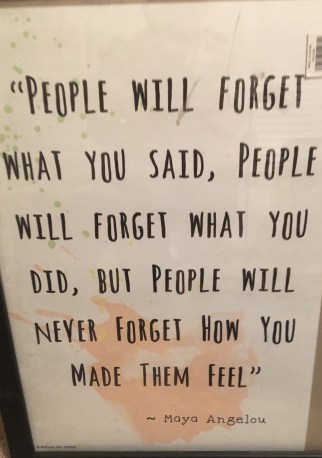
This is why religions and societies have moral and ethical rules of conduct and action, for example the Ten Commandments or the Buddhist Eightfold Path and related precepts. It’s not so much the “thou shall not” but rather that the effects of living by these moral codes may be more akin to the nature of ultimate reality and move you into a better mental place.
In the Chinese and Japanese traditions there are Hungry Ghosts or Gakis, beings that live in the ghost realm who have insatiable appetites but with a physiology (or a mental construct) that does not allow them to consume or enjoy the object of their desires. Ever been a Hungry Ghost?
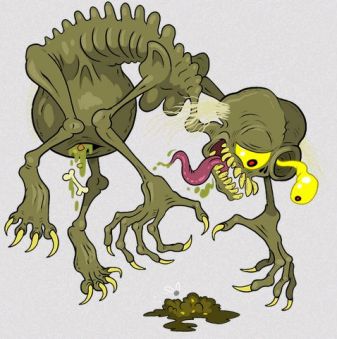
“There must be someway out of here, said the Joker to the thief” — Jimi doing Dylan’s All Along the Watchtower . With that said there are techniques to help evolve our little selves (and not suffer like the Gaki!). These include meditation and a whole family of actions what I call “surrender.”– Meditation next time. Where does this take us? There is a purpose to existence, and you are it! A great 7th century Chinese poem, the Sandokai or Harmony of Difference and Sameness frames phenomenon and “non-physical” spirituality. While humans seem solid, it can be said that the mind itself is the great mover of civilization and it may be well worth ones while to spend a little time each day in stillness. The resulting benefits may actually be one way to do our part to make a more positive and harmonious world.
 Little Known Mystic