

My roots are in Yoga, but I am also confirmed as a Lutheran and Episcopalian. Lately, over the last five years or so, the path has included Zen Buddhism. This blog will focus on the Yoga aspect, primarily my first method, and will reflect on our choices along the spiritual path. (What the heck, we have free-will!
I recently visited my good friend from college days (U.C. Santa Cruz) who lives near the, Hidden Valley Ashram, a men’s monastery, located in southern California in the hills above Escondido. The Ashram is affiliated with the Self Realization Fellowship (SRF) founded by Indian swami, mystic and guru, Paramahansa Yogananda. I had introduced my friend to the SRF organization back in 1969 and had just started taking the SRF lessons that summer, after a near fatal car accident
Yogananda was encouraged by his guru, Swami Sri Yukteswar to come to the United States and spread the “science” of Kriya Yoga to the west. Yogananda arrived in the States in 1920 and eventually established the Self Realization Fellowship (SRF), with headquarters in Encinitas, California. Surfer’s still hang out at Swami’s Point and ride the waves below the SRF grounds. Yogananda is the author of Autobiography of a Yogi, which is fascinating book whether you follow spiritual matters or not
Today, Self-Realization Fellowship has grown to include more than 500 temples and centers around the world and has members in over 175 countries. In India and surrounding countries, Paramahansa Yogananda’s work is known as Yogoda Satsanga Society of India (YSS), which has more than 100 centers, retreats, and ashrams.
A kind of humorous, but factual, article on SRF, including a stay at an SRF retreat at the Encinitas Ashram is described here: What Goes on Behind the Walls.
The SRF approach is very devotional and theistic, and interestingly includes Christ within the lineage of SRF gurus. While one may think this was Yogananda’s way of enticing westerner’s to yoga, it turns out that not him, but his guru, Yukteswar, supported the Guru-Christ lineage.
SRF teachings are offered online at a modest cost. The flagship technique taught is Kriya Yoga which is preceded and/or complimented by other less complicated, yet effective techniques. Kriya yoga is said to be an ancient yoga method and reintroduced via the SRF guru lineage in modern times. The technique is also offered by several other organizations which claim a link to this lineage. Kriya yoga definitely requires a teacher, or lessons and descriptively involves using both a mantra and visualization techniques, moving energy virtually up and down the spine. The Kriya yoga system consists of a number of levels of pranayama, mantra, and mudra based on techniques intended to rapidly accelerate spiritual development and engender a profound state of tranquility and God-communion. As Yogananda describes it: “The Kriya Yogi mentally directs his life energy to revolve, upward and downward, around the six spinal centers (medullary, cervical, dorsal, lumbar, sacral, and coccygeal plexuses)…One half-minute of revolution of energy around the sensitive spinal cord of man effects subtle progress in his evolution; that half-minute of Kriya equals one year of natural spiritual unfoldment.” Explained in the method is that human life is enabled through the cosmic energy of God. The visualization of energy and the power of the technique are explained as occurring in our astral or subtle body and the six spinal centers correspond to what are called chakras. Now of course, there is no scientific proof for an astral body, or for that matter chakras, but benefits of pranayama techniques or even some basic deep breathing have been shown to have positive health effects. While there are a lot of skeptics regarding chakras and non-physical bodies, quantum physics theories certainly allow possibility of such phenomenon.
Here’s my take on Yoga, SRF and Kriya yoga. At the Hidden Valley Ashram, I saw many happy people. They were not just happy for themselves, but happy for each other. There was a lot of power there! Any belief system that gets you to accept life and drop the “fighting and grasping” is good. We are all different and some prefer (or simply accept) a more devotional approach (yet that is not necessarily the core of Yoga), which is fine and can be very soothing. It is nice to know that there is a Loving God who ultimately takes care of you and in the end it will all turn out OK. There is really a plethora of Yoga methods (besides Kriya) and I think in order to be “serious” about them one has to have a teacher or belong to a group. Does Kriya Yoga work for me? Yes. I practice the basic Kriya and it puts me in a calmer space where I can get closer to seeing Reality without the “busy” ego getting in the way. Or, as Yogananda puts it, “When the mind is calm, it becomes the altar for the presence of God.” I find that it complements Zen style sitting, where the ego sits in the shadow of non-thinking. No technique is an end in itself. Both SRF teachings and Buddhist teachings bring up the analogy of the wave versus the Ocean and both approaches are about dissolving the negative aspects of the ego—the restless delusive consciousness of ego, in order to find the ocean of our true Selves (described by Yogananda as Soul and Spirit).
While best known for Autobiography of a Yogi, Yoganda’s lengthy and exhaustive translation and interpretation of the Bhagavad Gita, which he subtitled God Talks with Arjuna, in my opinion is his most important work. The link provided is from Amazon and the reviews are pretty indicative of the immense amount of metaphysical information in the book. Of course, very little of this, namely the metaphysical description of existence, has been proven or indicated by science to date. In a nutshell, it is God who thinks creation and is the source for our existence, which includes three bodies – the causal or consciousness body, the astral or life energy body and the physical body. In Vedic, Hindu and Yogic traditions there is an individualized “soul” which is the individualized reflection of ever-existing, ever-conscious, ever-new Joy, confined within the body of each and every being and is the true Self, whose ultimate source is Spirit or the non-dualistic God. (Buddhists philosophy tends to encourage cutting out the “middle man” and to just go for the non-duality).
The Great Battle of Life
Elucidating on the Gita’s primary metaphor of inner battle, Sri Yogananda writes, “From the moment of conception to the surrender of the last breath, man has to fight in each incarnation innumerable battles: biological, hereditary, bacteriological, physiological, climatic, social, ethical, political, sociological, psychological, metaphysical — so many varieties of inner and outer conflicts. Competing for victory in every encounter are the forces of good and evil. The whole intent of the Gita is to align man’s efforts on the side of dharma, or righteousness. The ultimate aim is Self-realization, the realization of man’s true Self, the soul, as made in the image of God, one with the ever-existing, ever-conscious, ever-new bliss of Spirit.” Yogananda goes on to explain in the book that the Ego is the evil and the good is the ultimate, if you will, Godhead. I love the fascinating picture from the Ramayana, Battle of Lanka, a Hindu/Vedic story that preceded the Gita but has the same epic battle theme between good and evil.
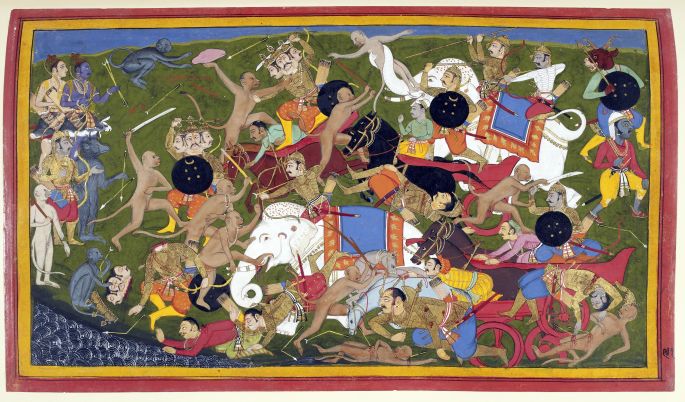
I think Buddhists also do great battle with the ego, but often it seems more cloaked — namely rather than engaging actively in the battle, Buddhist observe the battle in themselves. However, depending on the flavor of a particular Buddhist tradition, there are plenty of metaphors referring to swords cutting the grass (or even heads!) of delusion and of course the famous Bodhisattva, Manjusri, sitting on the demon (of the mind) Lion/Dog.
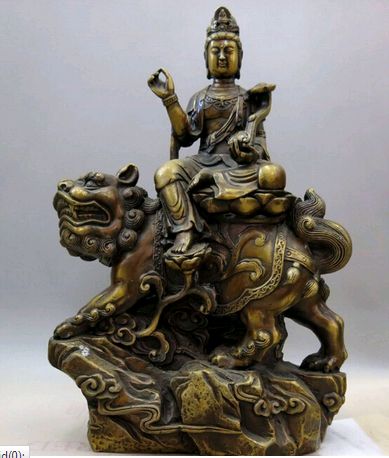
Both Yogic and Buddhist traditions ultimately strive to eliminate the delusive nature of ego and its grasping which simply is the noise and agent of misery that keeps us apart from ultimate Reality. Practicing pranayama techniques, including Kriya yoga, if it gets you closer to the place where you are not fighting this and that (are ready to let go), seems compatible with the ultimate goal of realizing our true nature. Further, Yogic and Buddhist traditions teach us to cultivate positive habits and actions – replacing good with bad – this may be the very fabric and foundation of both practices. But wait that is not all! By eventually letting go and realizing our true nature we also give Love and Joy to the Universe! We are that important! If Science gets to write the last sentence, it will be that there is one true Reality regardless of how you get there. Let’s just hope that the equations are simple. Keep in mind that Buddhism came from India and the two paths are historically intertwined. Follow your heart and recognize that your path will reflect who you are.
 Little Known Mystic
